


Rest, rhythm and recovery
A striking pattern among many people with persistent symptoms is that they are already doing a great deal right. They eat consciously, stay active, take supplements, try to go to bed on time and may already have tried different forms of therapy.
Yet the body may still not feel as though it is truly recovering.
That is one reason why I do not look at health only through the question "what is missing?", but also through a second question:
"In what state is this body trying to recover?"
Recovery does not only require the right building blocks. It also requires enough time, energy and regulation.
The nervous system is constantly setting priorities
Your autonomic nervous system helps regulate processes you do not have to think about consciously: heart rate, blood pressure, breathing, digestion and many adaptations to what is happening around you.
That system needs to be able to shift. When you need to perform or when there is real danger, more activation is functional. Afterward, there should be space again for rest and recovery.
The problem is not that the body has a stress response. That response is essential. Difficulties arise when stressors large and small begin to accumulate, leaving less and less room for recovery.
Stress is not only emotional. Sleep loss, an irregular routine, intense training, fasting, cold exposure, illness, constant mental stimulation and a demanding schedule are all sources of strain the body must respond to.
Not every healthy stimulus is healthy at every moment
This distinction matters.
Exercise can be healthy. Fasting can be useful in the right context. Cold can be a strong stimulus. A busy workday does not have to be a problem.
But the body does not only register the intention behind a stimulus. It has to process the total physiological load.
When someone sleeps well, has enough available energy and recovers easily, an extra stimulus may support adaptation. When that same person has slept poorly for weeks, is under high mental pressure and wakes up already exhausted, the same stimulus may mainly create extra recovery demand.
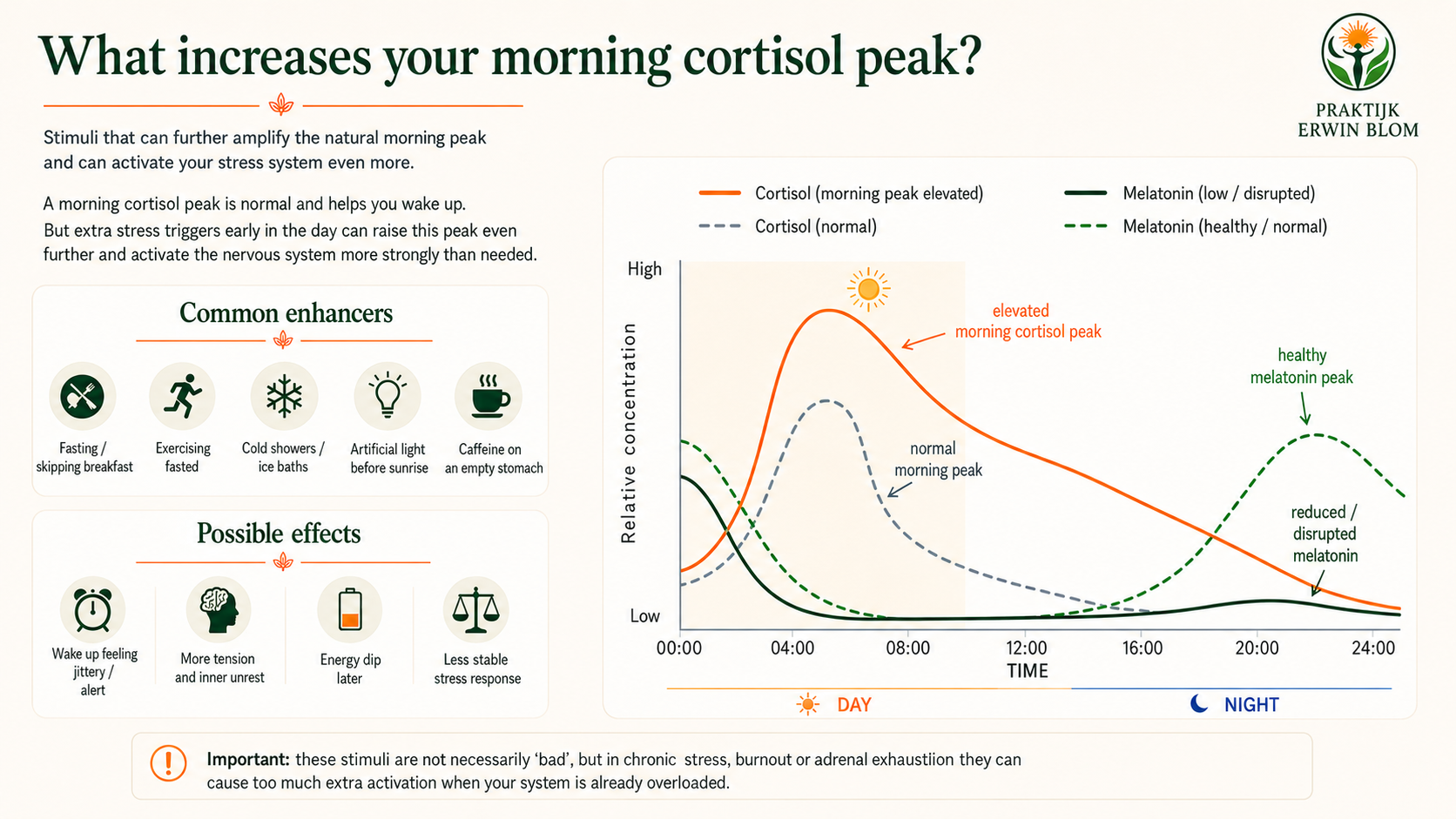
A stimulus is not automatically good or bad. Timing, dose and the total load on the system determine the context.
This is why I am careful with stacking interventions. Sometimes a body does not need to be pushed harder; it first needs more room to recover.
Chronic stress is not only in your head
Psychological stress has measurable physical effects. In human experimental studies, acute mental stress changed intestinal motility, autonomic activity, symptom perception and, in some studies, the absorption of water and electrolytes in the gut.
Sleep and stress also influence each other. One night of sleep deprivation can increase the cortisol response to a later stressor.
This does not mean that every digestive symptom or form of fatigue is caused by stress. It does show why separating mental strain from physical processes can give an incomplete picture.
The nervous system is one of the routes through which your environment and physiology meet.
Why relaxing sometimes does not work
People under long-term load are often advised to relax more. But when the system has been functioning in a high state of vigilance for a long time, relaxation cannot simply be forced.
You can lie on the couch while your mind keeps working. You can meditate while your body remains tense. You can spend eight hours in bed without getting eight hours of restorative sleep.
That is why I prefer to look at the conditions that make relaxation more likely:
- enough daylight and a clear day-night rhythm;
- less activating light and mental input in the evening;
- enough food and recovery between training sessions;
- predictable moments of rest;
- movement that fits current resilience;
- space to address emotional or practical stressors.
That may be less spectacular than one new technique, but it is often biologically more logical.
Rhythm lowers the number of decisions your body has to make
A stable rhythm makes the environment more predictable. When you usually wake, see outdoor light, eat, move and wind down at similar times, your system receives similar information again and again.
That does not mean regularity resolves every source of stress. It can, however, create a stable foundation that makes recovery easier.
For someone who constantly feels wired, that is often a better first step than adding even more health optimisation.
Recovery also depends on energy availability
Every recovery process requires energy. Muscles need energy to repair after training. Immune activity, digestion, temperature regulation, brain function and adaptation to stress all draw on the body's resources.
That is why I like to look at the relationship between load and available recovery capacity.
When demand is structurally greater than what the system can supply, the body may start compensating. You may notice poorer recovery, more sensitivity to stimuli, worse sleep or that normal demands suddenly feel much heavier.
This is not an exact calculation and not a medical diagnosis. It is a practical model for exploring why someone can get stuck despite good intentions.
Build capacity before adding more stress
Sometimes part of the process is surprisingly simple: better sleep, more morning light, less light late in the day, enough food, temporarily adjusting training load and leaving the day less full.
Not as the final goal, but to regain capacity.
When someone becomes more stable, more can often be added again. Training, cold, fasting or other hormetic stimuli may then be used in a more fitting way.
Recovery does not mean you need to live carefully forever. It means that load and capacity need to fit together again.
You can do many things right and still have symptoms
This may be one of the most important messages I want potential clients to hear.
You can eat healthily, take supplements, exercise and practise breathing techniques. Symptoms may still persist if sleep, daily rhythm, nervous-system regulation or the total strain on your body leaves too little room for recovery.
The solution is not automatically more discipline.
Sometimes a different perspective is needed: where is energy being depleted, which signals are keeping the system activated, and what could be adjusted to make recovery a realistic biological possibility again?
Further reading
Read A different way of looking at energy if you want to understand why nutrition and supplementation can matter, but may not always be enough.
For the role of timing and light, read Your biological clock as the foundation.
You can read more about how I bring these factors together in my approach.
Sources and further reading
- Kellow J.E. et al. Effects of acute psychologic stress on small-intestinal motility in health and irritable bowel syndrome. (1992), PMID: 1736343.
- Barclay G.R. & Turnberg L.A. Effect of psychological stress on salt and water transport in the human jejunum. (1987), PMID: 3582919.
- Rao S.S.C. et al. Psychological and physical stress induce differential effects on human colonic motility. (1998), PMID: 9647034.
- Minkel J. et al. Sleep deprivation potentiates HPA axis stress reactivity in healthy adults. (2014), PMID: 24818608.