


Your biological clock as the foundation
The biological clock is often reduced to one topic: sleep. But if you see it only as a sleep clock, you miss most of what it does.
Your circadian system helps the body organise processes in time. Not everything needs to be equally active at every moment of the day. Alertness should usually be higher during the day than deep at night. Melatonin should rise at the right time. Body temperature, hormone release, digestion and metabolism also show daily rhythms.
You can think of the biological clock as a conductor: it does not play every instrument itself, but it helps determine when different systems should take their turn.
Health is not only about what, but also about when
Lifestyle programmes often focus on content: what do you eat, how much do you move, which supplements do you use? These are relevant questions. But biology is also about timing.
The same stimulus can have a different effect at different moments. Light is a clear example. Bright morning light helps provide a new daytime signal. A lot of light late in the evening can shift the biological night later or weaken the melatonin response.
Meals, movement, sleep and daily activity also provide timing information to different systems in the body. The central clock in the brain is aligned mainly by light; many organs and tissues also have their own rhythmic clocks that need to stay coordinated.
Morning light sets the tone for the day
One of the most practical anchors is morning light.
When you are exposed to outdoor light after waking, the circadian system receives a clear signal that a new day has begun. Timed exposure to bright morning light can shift the phase of melatonin and cortisol rhythms. Under natural conditions, the hours of daylight also change with the seasons, continually giving the body information about day length.
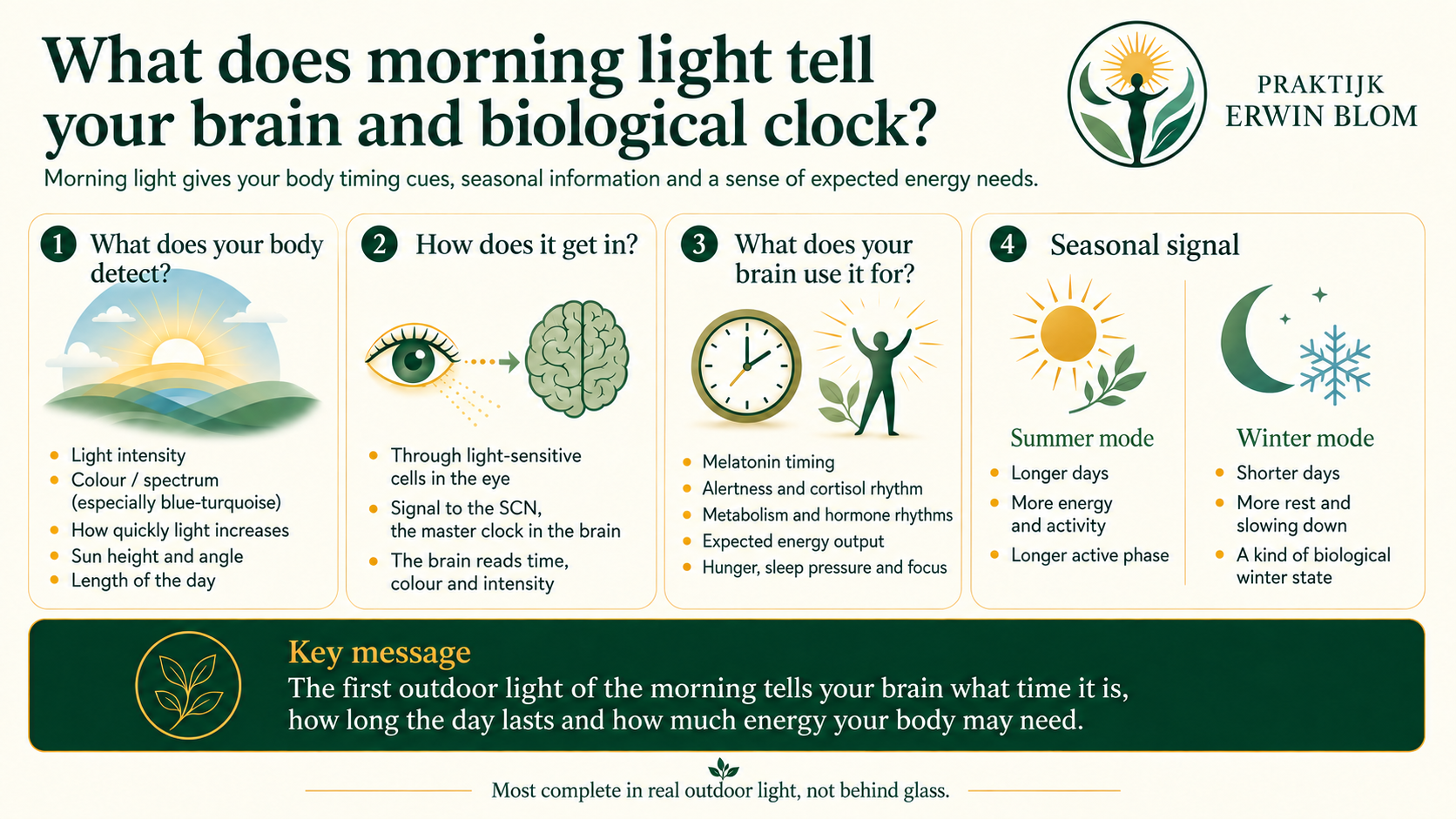
Morning light is a strong timing signal. The aim is not maximum light exposure, but a clear difference between day and night.
That is why I often do not start with complicated optimisation. First I want to know: what does your morning actually look like? Do you wake up and go outside, or do you start the day in a dark room looking straight at a screen?
That difference may seem small, but for internal timing it matters.
Cortisol and melatonin are not opponents
Cortisol is often simply called a stress hormone, and melatonin a sleep hormone. Both descriptions are too limited.
Cortisol has a normal daily rhythm and contributes, among other things, to mobilisation and alertness. Melatonin is mainly a hormonal signal of biological darkness. In a well-aligned rhythm, both have their place.
The problem is not that cortisol exists or that it rises in the morning. That is normal. The more interesting question is whether your rhythm fits the time of day and whether day and night still differ enough.
This also prevents a common trap: trying to suppress every physiological signal that gets labelled as stress. Health is not about being calm all the time. It is about being able to activate when needed and then recover again.
When the clock and your behaviour drift apart
Imagine that your body is biologically still in the night while your alarm tells you to perform. Or that you see bright light late in the evening and continue working intensely while your body should be moving toward night.
In the short term, people can compensate for this. We are flexible. But when it happens day after day, the risk of circadian misalignment increases: your internal timing and your behaviour no longer match well.
Human experimental studies show that this type of misalignment affects more than sleep. Glucose regulation can change too. Under controlled conditions, post-meal glucose levels were higher when participants were placed out of circadian alignment.
That is an important insight: rhythm is not only a sleep topic, but also a metabolic one.
Why regularity often creates calm
Predictability matters too. A body that receives light, food, activity and rest at roughly similar times each day has to switch less often between conflicting signals.
That does not mean life needs to be planned rigidly. A healthy system should be flexible. But flexibility works better when there is a stable foundation to return to.
For someone with low resilience, a simple and repeatable daily structure can sometimes do more than another protocol.
What can you observe yourself?
Before trying to fix anything, you can map your own rhythm:
- Do you usually wake around the same time, even without an alarm?
- Do you get outdoor light in the first part of the morning?
- Are you outside much during the day, or mostly indoors?
- When do you eat your final meal?
- How much artificial light do you use after sunset?
- Do you naturally become sleepy in the evening, or increasingly alert?
- Is there a big difference between workdays and weekends?
These questions often give more information than simply asking how many hours someone sleeps.
Restoring the clock does not mean living perfectly
The goal is not to become afraid of a late evening, a dinner out or a screen. A well-regulated body can handle exceptions.
The question is what you do most of the time.
When most days have a clear morning, daytime and evening pattern, a stronger foundation emerges. From there, the body can often handle occasional deviations better.
This is how I look at lifestyle: not as a collection of rules, but as offering consistent biological signals that help the system predict what is coming.
Why this is a foundation for me
When someone is tired, sleeps poorly or becomes less resilient, it is tempting to focus immediately on isolated deficiencies or symptoms. Sometimes that is necessary. But I also want to know whether the timing of the whole system still makes sense.
A body that does not clearly know when it is day or night has to compensate constantly.
That is why the biological clock has a central place in my approach. Not as an explanation for everything, but as a foundation that supports sleep, energy, recovery and many other processes.
Further reading
Continue with Rest, rhythm and recovery about the relationship between load, the nervous system and recovery capacity.
New to this topic? You may want to start with Why light matters more than you think.
You can read more about my way of working in my approach.
Sources and further reading
- Lemmer B. et al. Effects of bright light on circadian patterns of melatonin and cortisol in healthy subjects. (1994), PMID: 8180675.
- Vondrasová D. et al. Exposure to long summer days affects the human melatonin and cortisol rhythms. (1997), PMID: 9219878.
- Morris C.J. et al. Effects of the internal circadian system and circadian misalignment on glucose tolerance in chronic shift workers. (2016), PMID: 26771705.
- Qian J. et al. Differential effects of the circadian system and circadian misalignment on insulin sensitivity and beta-cell function in humans. (2018), PMID: 29862620.