


Why light matters more than you think
When we talk about health, the conversation often moves quickly to nutrition, movement, sleep and stress. These are important topics, but there is another layer that often receives far less attention: the light environment in which your body functions every day.
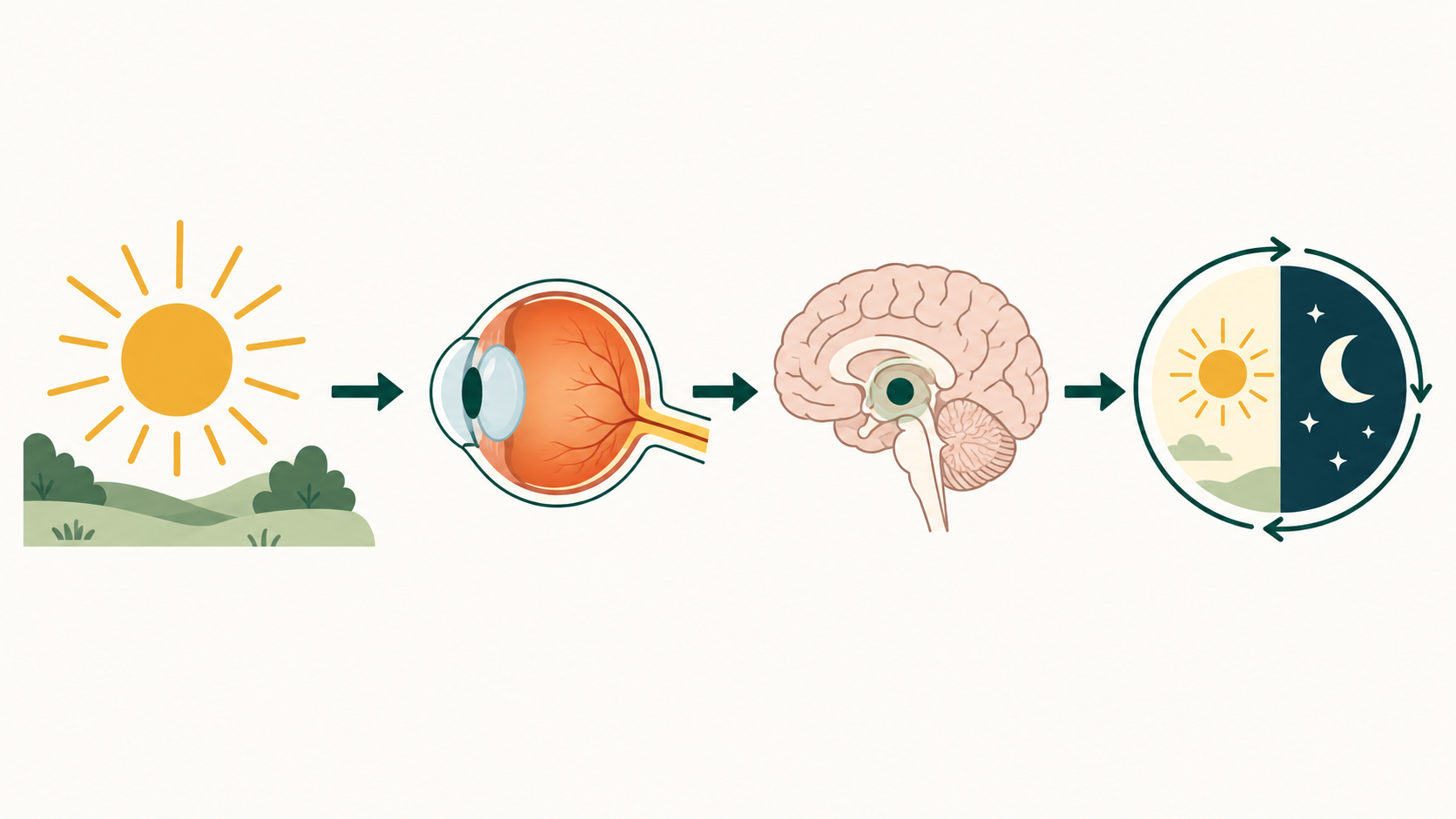
Light is not only needed for vision. Through specialised light-sensitive cells in the eye, it also sends information to systems involved in your biological clock. In that way, light helps the body determine when it is daytime, when activity makes sense and when it is time to prepare for night.
That makes light one of the most fundamental environmental signals our biology uses every day.
Your body notices not only how much light there is, but also when it arrives
Outdoors, light changes constantly. Morning light is relatively gentle. As the sun rises, its intensity increases and its spectral composition changes. Around sunset, that pattern shifts again before the natural environment becomes dark.
This alternation between light and darkness is a reliable timing signal for the body.
In modern life, that pattern is far less obvious. We may wake in a dimly lit home, spend most of the day indoors and then pass the evening under bright artificial light or in front of screens. We may know what time it is, but our biology responds primarily to cues from the environment.
That is one reason why I give so much attention to light at the right time of day in my work.
Melanopsin: light as timing information
In the retina, alongside rods and cones, there are light-sensitive retinal ganglion cells. Some of these contain the photopigment melanopsin. These cells respond strongly to light in the blue-cyan range and play an important role in non-visual light responses, including the alignment of the circadian rhythm.
Through this pathway, light can influence the timing of processes such as melatonin production, the sleep-wake rhythm and alertness. This does not mean that blue light is "bad". During the day, blue-rich light is a normal part of sunlight. Timing makes a big difference: a strong daytime signal makes sense during the day, while a lot of light late in the evening can keep giving the body a daytime signal.
From outdoor light to day-night rhythm

Why morning light is such an interesting first step
After the night, your biological clock benefits from a clear new daytime signal. Natural outdoor light in the morning is especially useful for this, because outdoor light is usually much stronger than indoor light, even on a cloudy day.
Human research shows that timed exposure to bright light can shift the phase of circadian hormone rhythms. The transition to bright morning light has also been shown to have direct effects on melatonin, cortisol and alertness.
That is why I see morning light as more than a simple wellness tip. It is a practical way to bring our environment into closer alignment with how the body perceives time.
In daily life this does not need to be complicated: go outside after waking, walk, drink coffee or tea in daylight, or simply begin part of your morning outdoors. The goal is not to follow a protocol perfectly, but to give the body a clear and recognisable start to the day.
In the evening, the opposite becomes important
Where the morning asks for a clear light signal, the evening asks for a gradual winding down.
Experimental research shows that ordinary room light before bedtime can suppress melatonin and delay the start of the melatonin period. Evening screen light can also affect sleep and circadian outcomes, with the melanopic component of light appearing especially relevant.
This does not mean you need to live in complete darkness after sunset. It mainly means that it makes sense to use less, softer and warmer light in the evening than in the middle of the day.
You can think of it as contrast: a strong day and a clear night. That difference helps your biological clock distinguish the two phases.
Where quantum biology becomes practical in my work
The term quantum biology can sound complicated. In my practice I use it mainly as a broader way of looking at the interaction between the body and its physical environment, with light as one of the most important parts.
I make a distinction between what is well supported by chronobiology and light physiology, and ideas that are more theoretical or still emerging. For a client, the terminology is ultimately less important than the practical question:
Is your body receiving the signals it needs at the right time?
You can eat well and pay a lot of attention to health, but if your days biologically resemble your nights, an important foundational layer may be missing.
Light is not a treatment for everything
It would be too simplistic to attribute every symptom to an unsuitable light environment. Fatigue, sleep problems, hormonal symptoms or low resilience can have many different causes, and medical investigation may sometimes be necessary.
But light is a factor that influences almost everyone every day. That is why I find it logical to take this foundation seriously before simply adding more interventions.
For some people, that is exactly the shift that is needed: not only asking what should I take?, but also in what environment is my body trying to function?
A good first step
If this is new to you, you do not need to change your whole life at once. Start with three observations:
- How soon after waking do you go outside?
- How many hours of your day do you truly spend in natural daylight?
- How bright and blue-rich is your environment in the last two hours before sleep?
Those questions alone often make visible how different our modern environment is from the rhythm to which the body is adapted.
Further reading
Next, read Your biological clock as the foundation to understand why timing affects sleep, hormones and metabolism.
Would you like to see how this fits into a broader, personalised approach? Read more about my approach.
Sources and further reading
- Lemmer B. et al. Effects of bright light on circadian patterns of cyclic adenosine monophosphate, melatonin and cortisol in healthy subjects. (1994), PMID: 8180675.
- Leproult R. et al. Transition from dim to bright light in the morning induces an immediate elevation of cortisol levels. (2001), PMID: 11231993.
- Gooley J.J. et al. Exposure to room light before bedtime suppresses melatonin onset and shortens melatonin duration in humans. (2011), PMID: 21193540.
- Schöllhorn I. et al. Melanopic irradiance defines the impact of evening display light on sleep and circadian physiology. (2023), PMID: 36854795.