


What is leptin? More than a satiety hormone
Why are you hungrier on some days than on others? And why can a period of eating less eventually make food occupy more of your thoughts? There are several possible explanations. One signal involved is leptin.
Leptin is often called the satiety hormone. That description is understandable, but the story is broader. It helps the brain receive information about the body's energy stores and belongs to a network involved in regulating appetite and energy balance.
A message from fat tissue to the brain
Leptin is a hormone released mainly by fat cells. It travels through the blood to several areas, including the hypothalamus, a part of the brain involved in regulating many bodily processes.
Leptin levels are related, among other things, to the amount of fat tissue. The signal can also change when energy intake changes substantially. This gives the body information that goes beyond whether you have just eaten.
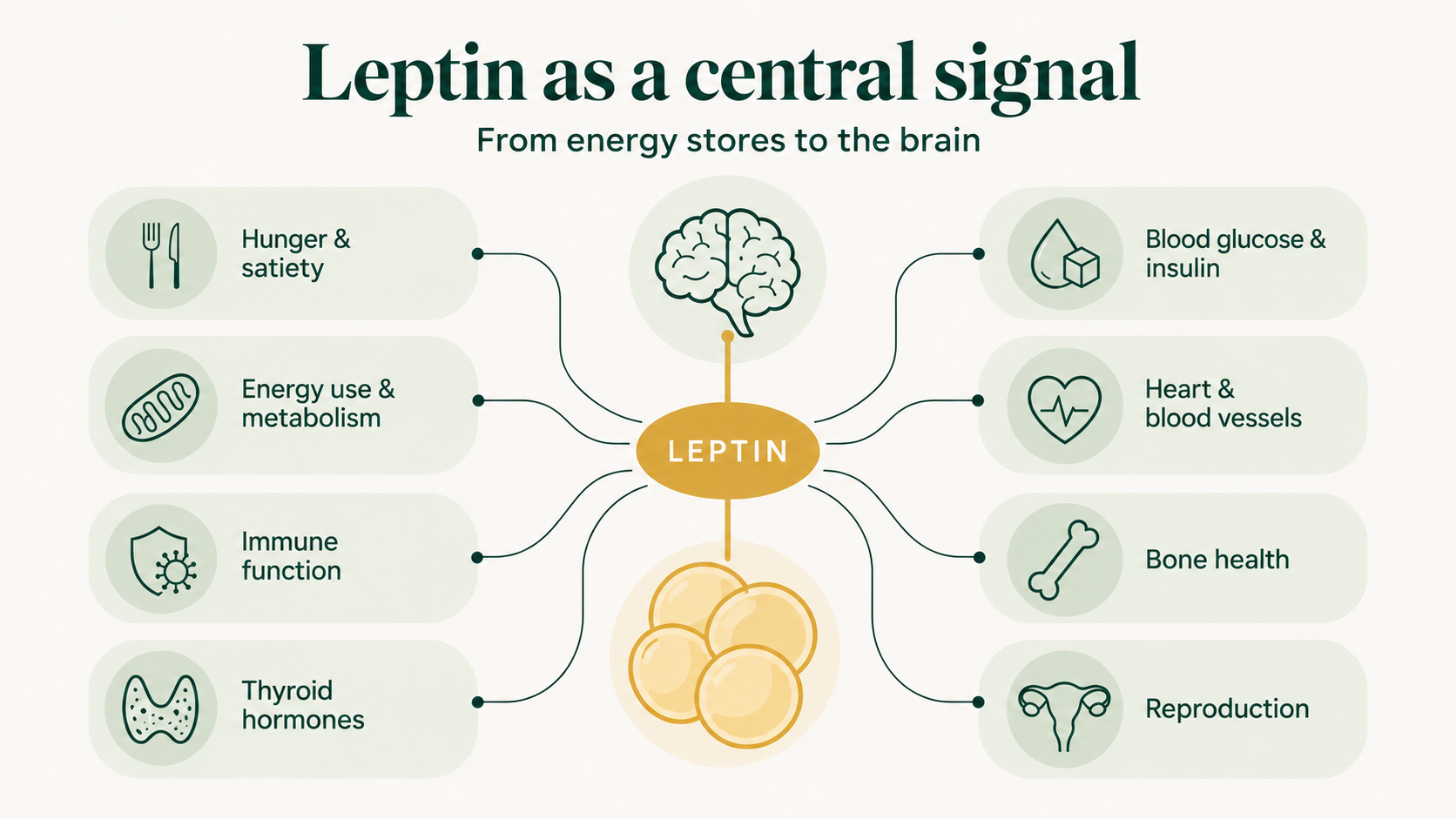
This diagram offers a simplified view of bodily processes that research has linked to leptin.
You could compare leptin to a message about energy reserves. The brain processes this message alongside other signals to help regulate appetite and energy balance. It reflects information about reserves rather than measuring exactly how energetic you feel today.
Fullness involves several signals
After a meal, the composition of your food, signals from your stomach and intestines, and past experiences all influence how hungry you still feel. Leptin works within this larger system. It is not an on-off switch that immediately decides after every meal whether you have eaten enough.
Hunger is not controlled by one hormone either. Bodily signals, sleep, surroundings, habits and access to food all influence the desire to eat. Appetite is human and complex.
What happens when the signal changes?
Imagine eating considerably less than usual for a period. Your body receives less food and different information about what is available. You might notice that food occupies more of your thoughts: appetite is one way the body responds to changing circumstances.
Researchers try to separate parts of this response under controlled conditions. This helps clarify the role leptin plays alongside other signals.
Leptin can fall during prolonged or substantial restriction of energy intake. In a small study of healthy men during short-term fasting, researchers found that leptin may contribute to hormonal adaptations to limited energy availability.
The reverse also deserves care. People with more fat tissue often have higher leptin levels, but that does not mean they always feel full. How the brain responds to the signal remains a subject of research. A single value does not tell the whole story.
Leptin has a rhythm too
Leptin has a daily rhythm: levels change across the day and night.
Controlled human studies have found daily fluctuations, with both the biological clock and sleep and eating patterns playing a part. The signal is connected to the timing of your day.
For me, that interconnectedness makes the subject interesting. No hormone operates in isolation. Food, sleep, activity and daily timing together form the context in which signals arise and are processed.
Continue reading
Read my approach to learn how I consider someone's daily context.
What happens when your rhythm or energy intake changes? Explore Why does the leptin signal change?.
For the possible relevance to persistent symptoms, read Leptin and symptoms: what can we learn?.
Sources and further reading
- Chan J.L. et al. Leptin and adaptation to short-term fasting in humans. Journal of Clinical Investigation.
- Shea S.A. et al. Biological timing, sleep and leptin in humans. PubMed, PMID 15687326.