


A different way of looking at energy
Why nutrition and supplements are often not enough
When you do not feel well, nutrition is a logical place to begin. You may eat more protein, avoid certain foods, try to keep blood sugar more stable or use supplements for possible deficiencies.
That can absolutely be valuable.
Still, I regularly see people who pay a lot of attention to nutrition and supplementation, yet experience little real progress. The next step then often becomes eating even more specifically, doing another test, adding another supplement or following another protocol.
Sometimes that is appropriate. But sometimes we keep searching within the same layer while the issue is broader.
Nutrition provides raw materials. The next question is: what condition is your body in when it has to digest, distribute and use those raw materials?
Building blocks matter, but they are not the whole process
A protein-rich meal contains amino acids. A mineral supplement contains minerals. A capsule can provide a vitamin.
But between taking something in and being able to use it biologically, many steps are involved: digestion, absorption, transport, cellular processing, hormonal signalling and ultimately repair or growth.
These processes do not exist separately from sleep, circadian rhythm, stress physiology and energy availability.
That is why I will never call nutrition unimportant, but I also do not look at it as an isolated system.
A different question: how high is the energy demand?
Imagine the body as a system with a certain energy supply and a certain energy demand.
On the supply side are factors such as enough food, oxygen transport, sleep, recovery and the capacity of cells to make energy available.
On the demand side are all processes that cost energy: work, thinking, movement, digestion, temperature regulation, immune activity, emotional load, training and constant adaptation to the environment.
Ideally, there is enough room between the two. You have enough energy not only to get through the day, but also to maintain a reserve for recovery and adaptation.
Energy production and demand do not tell the whole story. The body sends internal signals about its state, and the brain integrates them as it regulates energy. It is also possible for energy to be available without feeling accessible, if those signals are not clearly communicated or processed. Fatigue alone cannot tell us whether this is happening; it is one possibility to consider alongside energy supply and demand.
In modern life, that margin can become increasingly narrow.
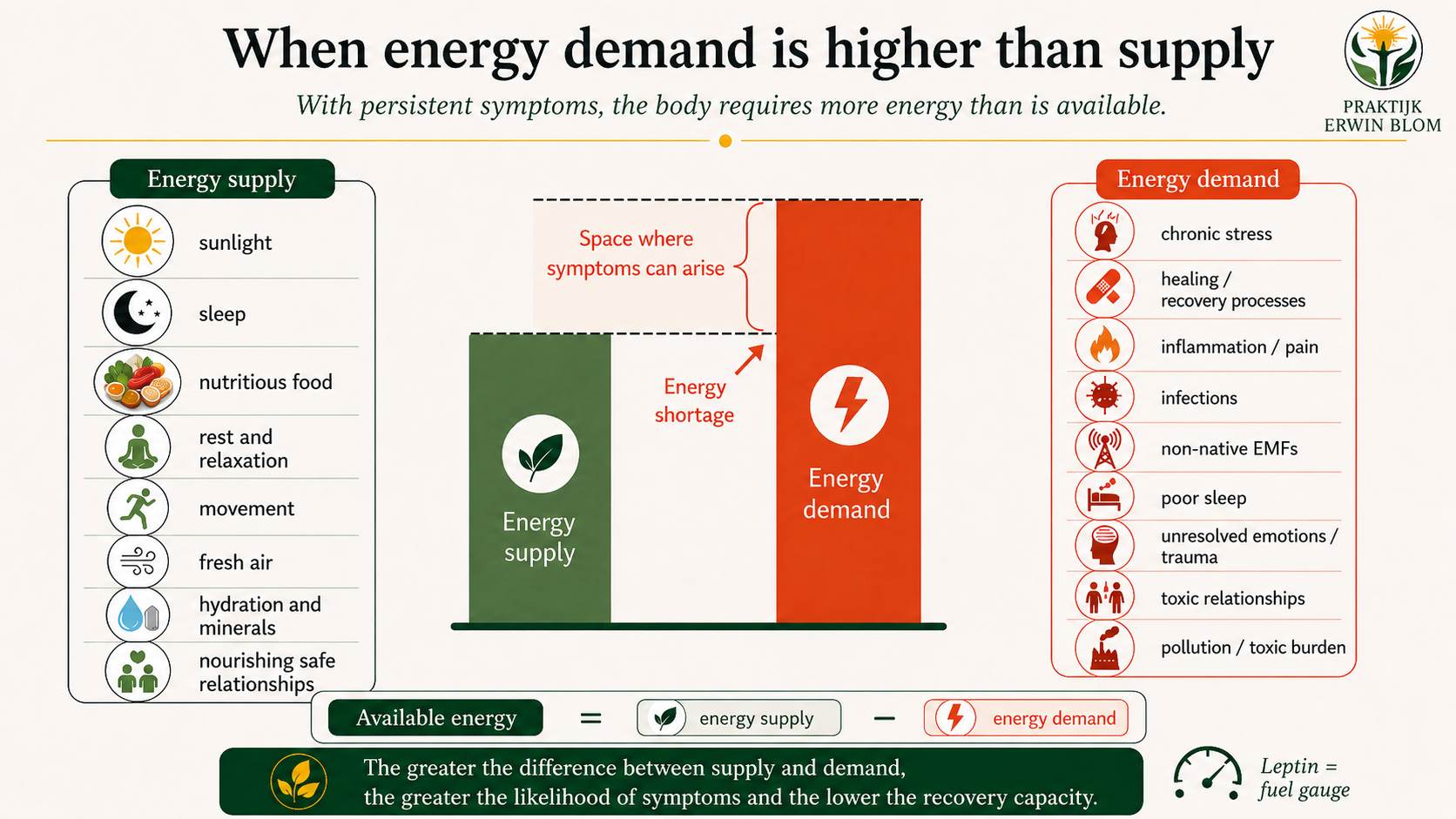
A practical model: when total demand stays high while recovery capacity lags behind, there is less room for repair, growth and resilience.
The modern environment can quietly increase demand
Think not only of major stressful events. The combination of smaller stimuli can also matter:
- too little sleep;
- heavy mental load;
- being constantly reachable;
- intense training without enough recovery;
- large differences between weekday and weekend rhythm;
- little daylight during the day;
- a lot of light and screen use in the evening;
- eating too little in relation to activity;
- long fasting periods while resilience is already low.
None of these factors has to be a problem on its own. It is about the sum and the context.
When demand rises, extra nutrients may still be useful, but they may not solve the underlying limitation.
A good supplement cannot replace a poor night
This sounds obvious, but in practice we often behave as if it can.
We try to compensate for fatigue with stimulants. We take magnesium while working late under bright light. We look for a supplement for blood sugar while sleep and biological timing remain structurally disrupted.
Experimental research shows, for example, that circadian misalignment can worsen glucose handling, separate from other behavioural factors. Sleep loss can also strengthen the physiological stress response.
This does not mean supplements are pointless. I mainly want to make clear that context determines how much leverage a supplement can truly have.
Supplements work best as tools, not as the foundation
Targeted supplementation can be very useful when there is a clear reason: a demonstrated deficiency, increased need, a restricted diet or temporary therapeutic use under appropriate guidance.
But ultimately I want someone to become less dependent on endless jars, not more.
That is why I like to ask three questions about supplementation:
1. Why are we using this?
2. Which issue do we expect it to influence?
3. When will we know it is no longer needed?
That prevents a supplement list from slowly growing without anyone still knowing the original reason.
Light and timing change how I look at nutrition
One of the most interesting lessons from circadian biology is that the body does not respond in exactly the same way at every moment of the day.
In controlled human studies, glucose handling varies with the internal circadian phase. When the internal clock and behaviour are artificially brought out of alignment, the glucose response worsens further.
That does not make nutrition only a clock problem, but it does show that what you eat and when you eat are not fully separate.
For me, this is a good example of why a broader approach is needed. Food quality matters, but the body processes that food within a 24-hour physiological rhythm.
The nervous system helps shape the conditions for digestion
The nervous system is part of this picture too.
Human research shows that psychological stress can change gut function. Depending on the stressor used, effects have been observed on motility, autonomic activity, symptom perception and intestinal water and salt transport.
This does not mean stress explains every digestive symptom. But it does show why a perfect meal plan does not automatically lead to perfect digestion.
You can offer the best ingredients while the system receiving them remains under pressure.
Sometimes you do not need to add more, but lower the demand
For many people this is an important shift.
Recovery does not always begin with more interventions. Sometimes space appears when we temporarily ask less:
- reducing training volume;
- making the evening calmer;
- prioritising sleep;
- eating more regularly when long fasting is not well tolerated;
- getting more outdoor light during the day;
- using less bright artificial light in the evening;
- addressing practical sources of stress;
- creating enough empty space in the week.
At the same time, we can support supply with quality food, enough protein and micronutrients, recovery and, where appropriate, targeted temporary supplementation.
The aim is for demand and supply to come closer together again.
Symptoms do not automatically point to a deficiency
When you are tired, you may think of iron, B12, magnesium or thyroid hormones. That can be appropriate and should be medically investigated where needed.
But not every form of fatigue means that one substance is missing. Sometimes the whole system has simply been under load for too long for the available recovery capacity.
That is not a reason to ignore physical causes. Exactly the opposite. It is a reason to see medical diagnostics, nutrition, lifestyle, environment and the nervous system not as competing explanations, but as different layers of the same whole.
My starting point: understand first, then add
That is why I do not try to create a long list of advice as quickly as possible. First I want to understand where the greatest load is and where the greatest leverage for recovery is likely to be.
For one person that may be nutrition. For another, sleep. For someone else, the day-night rhythm, training load, ongoing stress or a combination.
Supplements can be part of the plan, but they do not have to become the centre of it.
Ultimately, the goal is that your body not only receives more building blocks, but also better conditions in which to use them.
Further reading
Read Rest, rhythm and recovery for the role of the nervous system and total load.
Would you first like to understand why light has such a central place? Read Why light matters more than you think.
You can read more about how I bring these elements together in a personalised way in my approach.
Sources and further reading
- Morris C.J. et al. Effects of the internal circadian system and circadian misalignment on glucose tolerance in humans. (2016), PMID: 26771705.
- Qian J. et al. Differential effects of the circadian system and circadian misalignment on insulin sensitivity and beta-cell function in humans. (2018), PMID: 29862620.
- Minkel J. et al. Sleep deprivation potentiates HPA axis stress reactivity in healthy adults. (2014), PMID: 24818608.
- Barclay G.R. & Turnberg L.A. Effect of psychological stress on salt and water transport in the human jejunum. (1987), PMID: 3582919.
- Quigley K.S. et al. Functions of Interoception: From Energy Regulation to Experience of the Self. Trends Neurosci. (2021), 44(1):29–38. doi: 10.1016/j.tins.2020.09.008.