
My perspective
Together, we explore what may be putting pressure on your energy production and recovery. We use that understanding to make purposeful changes to your rhythm, nutrition, daily demands and the conditions that help you recover.
Starting with energy
Modern life can ask a lot of us: work, constant stimulation, worries and a full schedule. Short nights, irregular meals and little time to recover can make those demands harder to manage. You may feel that life is asking more of you than you have available.
My approach centres on the relationship between energy production, daily demands and recovery. Your cells turn nutrients into usable energy, much of it through the mitochondria. Together, we explore the conditions that support this process and the factors that may be contributing to your fatigue or limited capacity to recover.
Signalling may also be part of the picture. Energy may be available, yet the signals about it may not be communicated or processed clearly by the brain. As a result, that energy may not feel accessible. This, too, is one possibility we can explore.
For a long time, I believed that emotional factors played a major role in people’s symptoms. That is why I take emotional experiences seriously. Can letting go of emotional burdens create more room to feel energised? For some people, it can be a meaningful part of their process.
I would never suggest skipping that work. I am not a specialist in emotional therapy myself, but my life partner is. My own guidance focuses on energy production, everyday demands and recovery, and can sit alongside that support.
Your symptoms give us a starting point. We look for underlying factors and patterns we can influence, so that each change has a clear purpose and fits what your body needs.
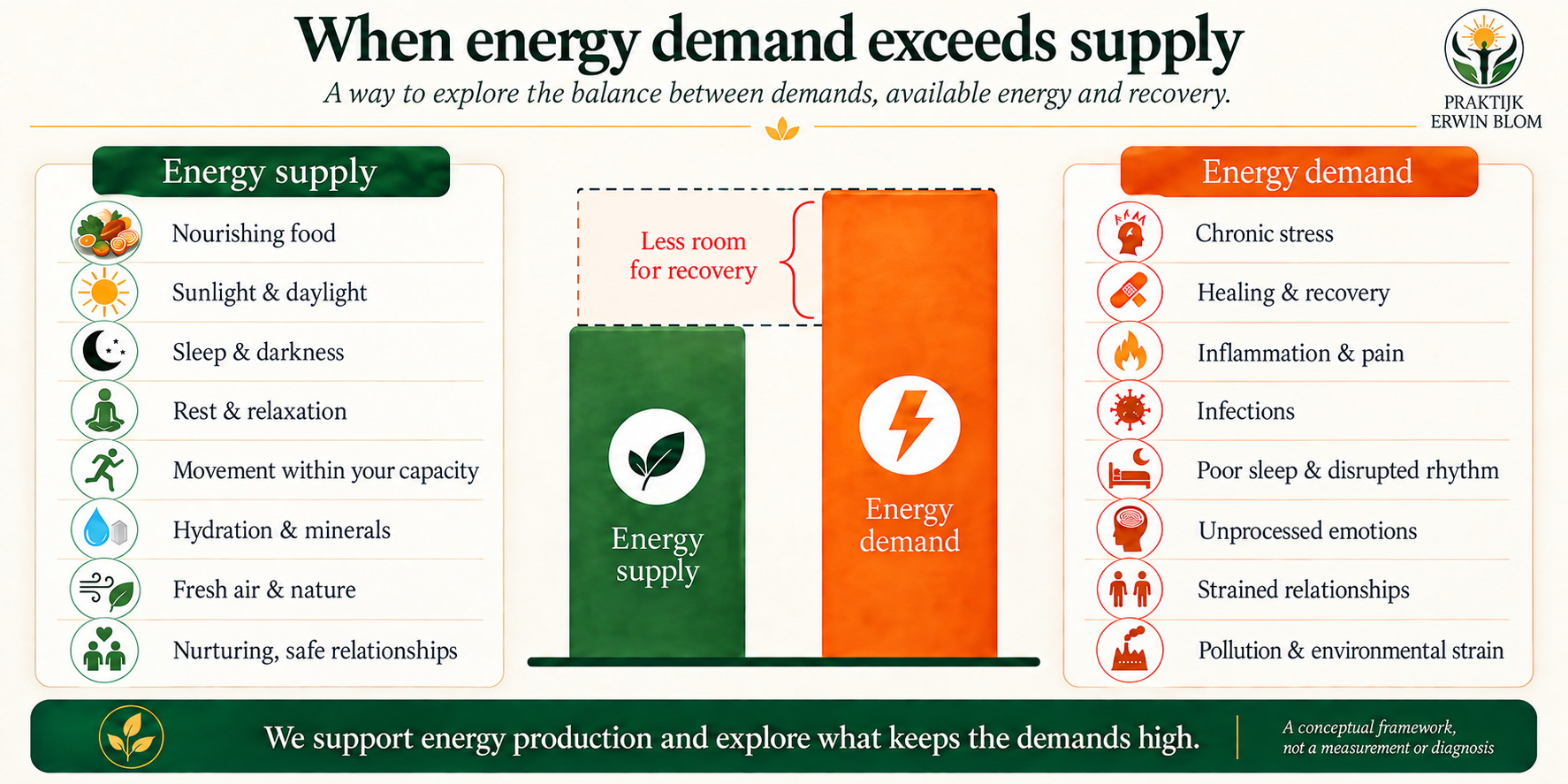
When energy demand exceeds supply. A way to explore the balance between demands, available energy and recovery. Energy supply: Nourishing food; sunlight and daylight; sleep and darkness; rest and relaxation; movement within your capacity; hydration and minerals; fresh air and nature; nurturing, safe relationships. Energy demand: Chronic stress; healing and recovery; inflammation and pain; infections; poor sleep and disrupted rhythm; unprocessed emotions; strained relationships; pollution and environmental strain. The green supply bar is lower than the orange demand bar: less room for recovery. We support energy production and explore what keeps the demands high. A conceptual framework, not a measurement or diagnosis.
Rhythm and energy production
Quantum biology broadened the way I think about health. I consider the environment in which your body functions every day. Light and darkness, sleep, food, movement and relaxation all help shape the conditions in which energy is used and recovery takes place.
Your biological clock helps coordinate sleep, alertness, hormone release and metabolism. We explore how your daily rhythm fits your life: when you get daylight, when you eat and when your body has a real opportunity to rest.
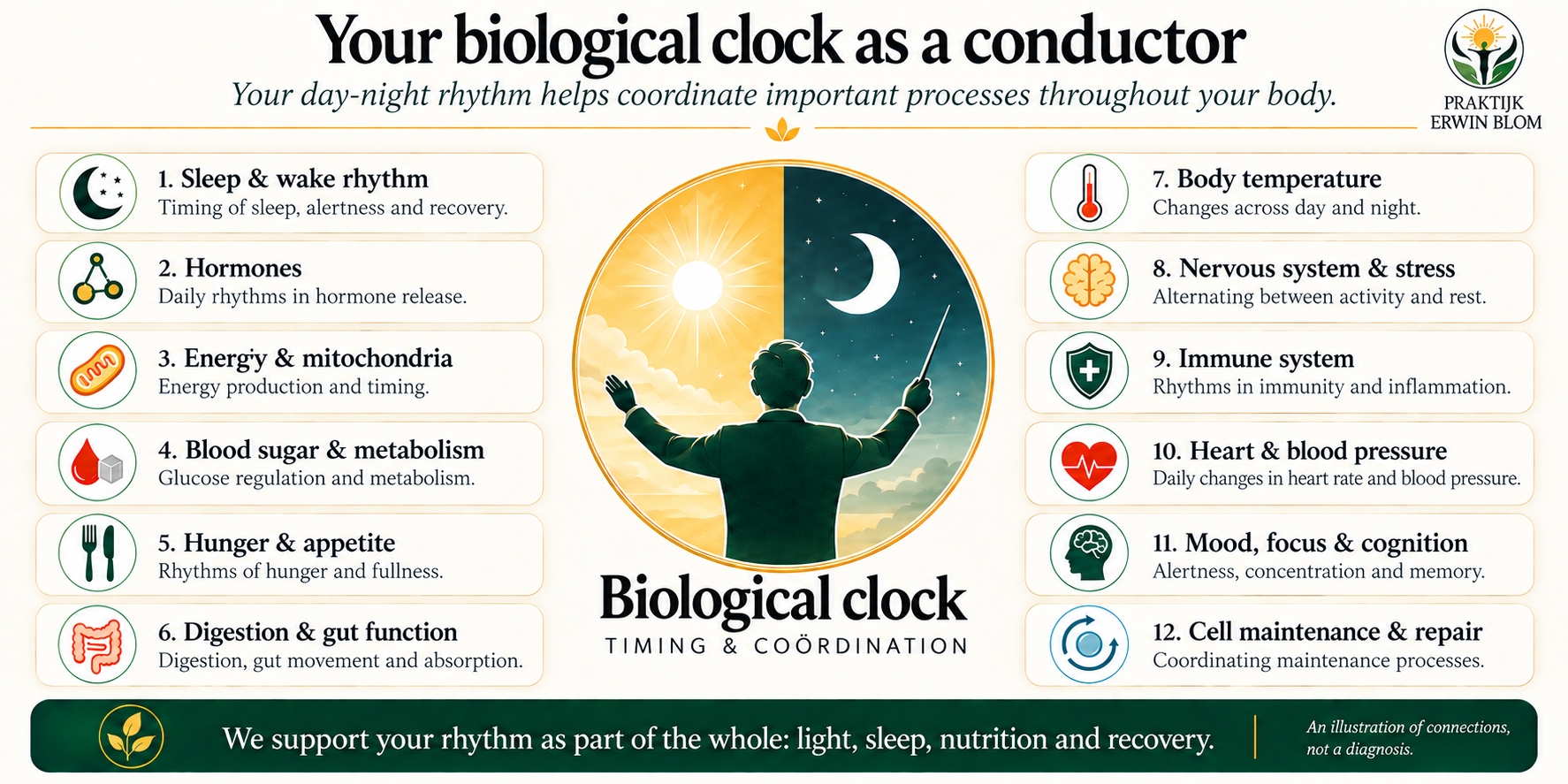
Your biological clock as a conductor. Your day-night rhythm helps coordinate important processes throughout your body. 1. Sleep and wake rhythm: timing of sleep, alertness and recovery. 2. Hormones: daily rhythms in hormone release. 3. Energy and mitochondria: energy production and timing. 4. Blood sugar and metabolism: glucose regulation and metabolism. 5. Hunger and appetite: rhythms of hunger and fullness. 6. Digestion and gut function: digestion, gut movement and absorption. 7. Body temperature: changes across day and night. 8. Nervous system and stress: alternating between activity and rest. 9. Immune system: rhythms in immunity and inflammation. 10. Heart and blood pressure: daily changes in heart rate and blood pressure. 11. Mood, focus and cognition: alertness, concentration and memory. 12. Cell maintenance and repair: coordinating maintenance processes. Biological clock: timing and coordination. We support your rhythm as part of the whole: light, sleep, nutrition and recovery. An illustration of connections, not a diagnosis.
From symptoms to patterns
Poor sleep can reduce your capacity to cope. Ongoing stress can affect sleep and eating habits. When you feel exhausted, it can also become harder to do the things that support recovery. These factors can reinforce one another.
We consider your story, lifestyle, daily demands and any relevant test results together. Where are the demands too high? What makes adequate nutrition, rest or recovery difficult? Are there signs of a deficiency or another cause that needs further investigation? Symptoms or a Corpus Analyser scan alone cannot establish a deficiency.
The domino illustration is a way to explore these connections, rather than a sequence everyone goes through. We identify which patterns are relevant to you and choose practical areas to work on.
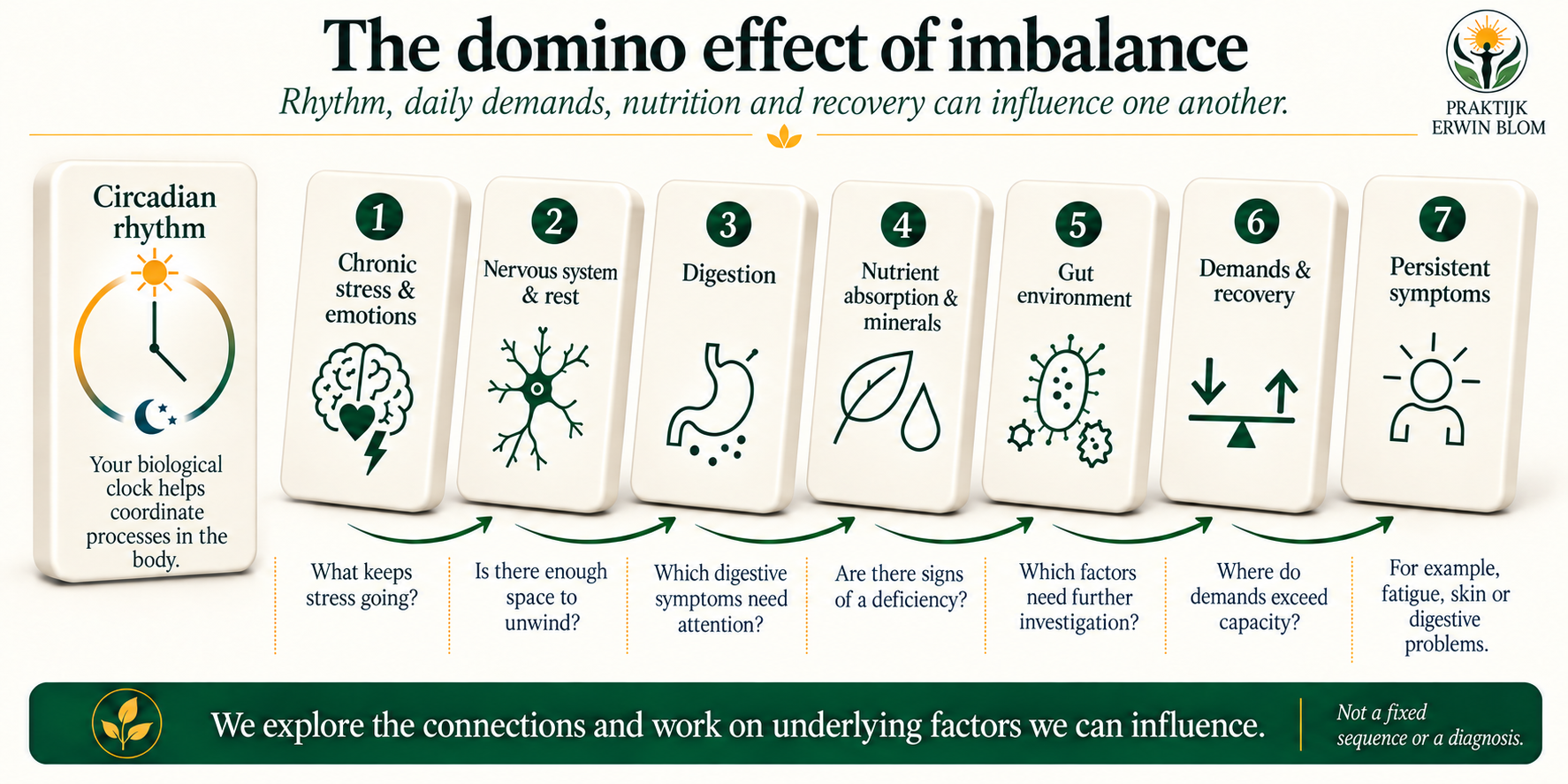
The domino effect of imbalance. Rhythm, daily demands, nutrition and recovery can influence one another. Circadian rhythm: your biological clock helps coordinate processes in the body. 1. Chronic stress and emotions: what keeps stress going? 2. Nervous system and rest: is there enough space to unwind? 3. Digestion: which digestive symptoms need attention? 4. Nutrient absorption and minerals: are there signs of a deficiency? 5. Gut environment: which factors need further investigation? 6. Demands and recovery: where do demands exceed capacity? 7. Persistent symptoms: for example, fatigue, skin or digestive problems. We explore the connections and work on underlying factors we can influence. Not a fixed sequence or a diagnosis.
Building capacity, step by step
We work on both sides of the balance: supporting the conditions for energy production and recovery, while reducing demands where possible. This may involve a daily rhythm that suits you, nourishing food, enough rest and movement that respects your current capacity. Where a deficiency has been confirmed, we consider the appropriate next step.
By your own blueprint, I mean what is particular to you: your needs, sensitivities, possibilities and the things you want to be able to do again. The aim is to help you feel more energised, experience fewer symptoms and have greater freedom in daily life.
We build towards this gradually, choosing realistic priorities and reviewing how you respond. Your experience and capacity set the pace.
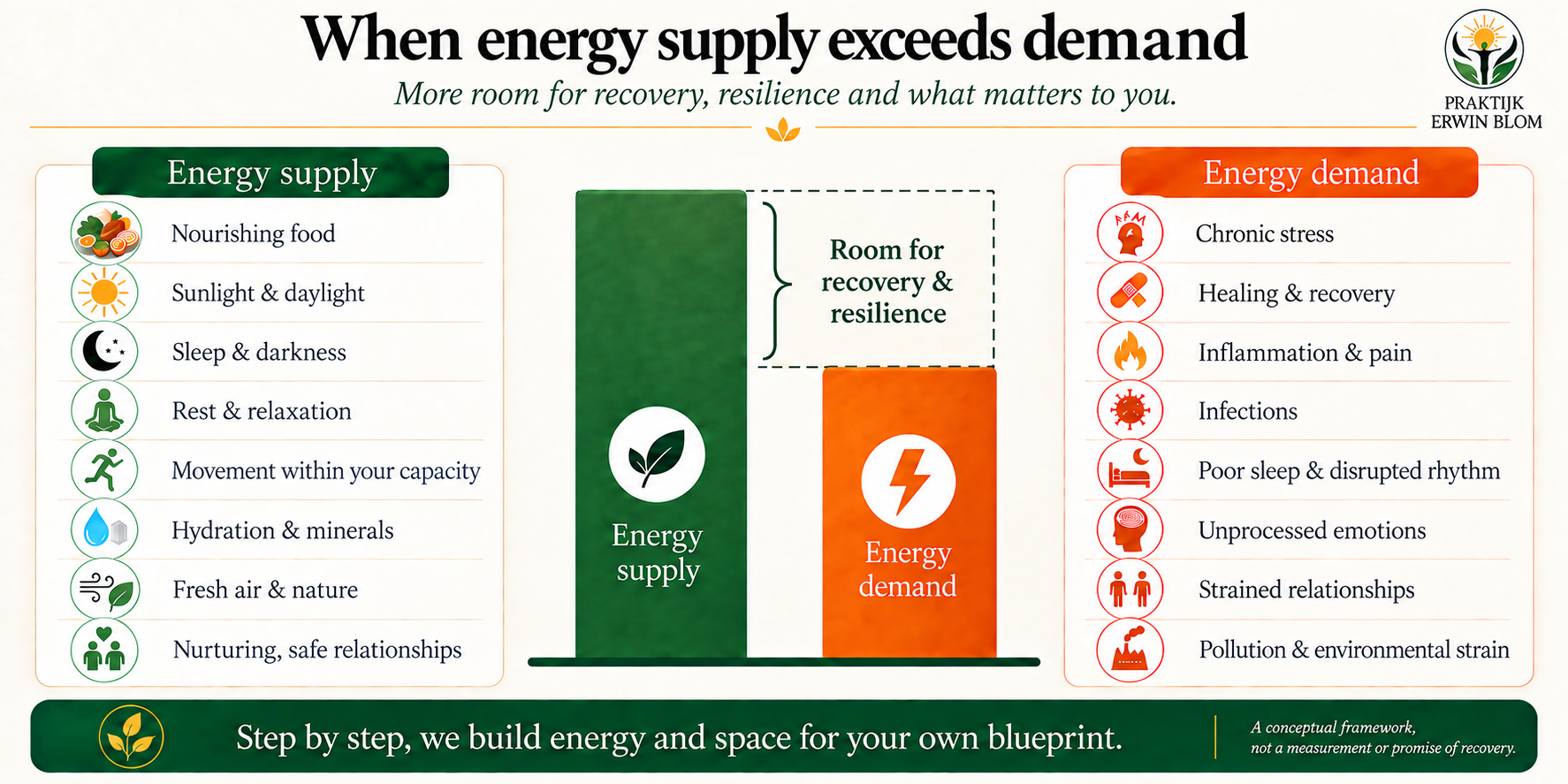
When energy supply exceeds demand. More room for recovery, resilience and what matters to you. Energy supply: Nourishing food; sunlight and daylight; sleep and darkness; rest and relaxation; movement within your capacity; hydration and minerals; fresh air and nature; nurturing, safe relationships. Energy demand: Chronic stress; healing and recovery; inflammation and pain; infections; poor sleep and disrupted rhythm; unprocessed emotions; strained relationships; pollution and environmental strain. The green supply bar is taller than the orange demand bar: room for recovery and resilience. Step by step, we build energy and space for your own blueprint. A conceptual framework, not a measurement or promise of recovery.
This perspective shapes how we explore your story and daily life. Read what preparation, appointments and personal support look like in practice.

